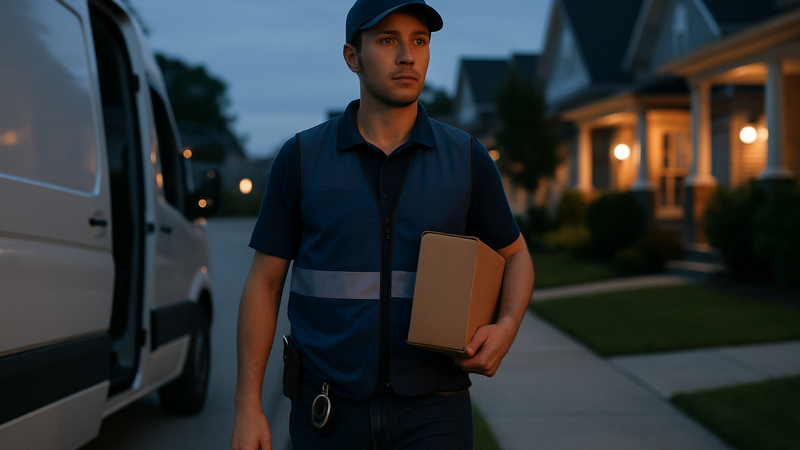
The 6 essential self-defense tools for delivery drivers are a personal alarm, pepper spray, a stun gun, a dash or body camera, a window breaker/seatbelt cutter tool, and a vehicle door alarm. Together, these tools cover the three moments of highest risk on any route: approaching a door, walking back to the vehicle, and being inside the vehicle itself. Each one is small enough to carry every shift and simple enough to use without training.
Every delivery driver knows the feeling. You pull up to a house you’ve never been to, in a neighborhood you don’t know, sometimes after dark, and you walk up to a stranger’s door alone. Most stops are nothing. But it only takes one bad stop to change how you think about the job forever. I have spent over 30 years helping people prepare for the moment they hope never comes, and delivery drivers are some of the hardest-working, most exposed people I talk to. You are in and out of your vehicle dozens of times a day, often in unfamiliar territory, often alone, and often after the sun goes down.
This is where I want to sound the alarm — not to scare you, but to make sure you are covered at every point of exposure on your route. Let me walk you through the six tools that belong in your vehicle, on your belt, or in your delivery bag before your next shift.
What is the most important self-defense tool for a delivery driver?
The single most important tool is a personal alarm, because it works instantly, requires no physical confrontation, and alerts everyone nearby the moment something feels wrong. A loud alarm in the 120–130 decibel range can stop an approach before it becomes a problem, buying you the seconds you need to get back to your vehicle or reach a lit doorway.
Here is why this matters more than people think: most dangerous situations for delivery drivers do not start as attacks. They start as an uncomfortable feeling — someone following you back to the van, a dog off leash, a stranger walking up too fast in a dark driveway. A personal alarm interrupts that moment immediately. It draws attention, it startles, and it tells anyone watching that you are aware and prepared. Clip one to your bag strap or keychain so it is always within reach, not buried at the bottom of your bag.
If you want to compare options built for exactly this kind of daily carry, our guide to the best self-defense tools breaks down alarm decibel ratings side by side.
Should delivery drivers carry pepper spray?
Yes — pepper spray is one of the most practical tools for delivery drivers because it creates distance without requiring you to make physical contact with anyone. A compact canister clips easily to a belt loop, lanyard, or bag zipper, and it is legal to carry in the vast majority of states for personal protection.
What I want you to pay close attention to is range and wind control. A short-range spray meant for close encounters is not ideal if someone is approaching from across a yard or driveway. Look for a stream or foam-based option, since these travel further and are less likely to blow back toward you outdoors. Brands like Mace and Wildfire make formulas built specifically for outdoor, unpredictable conditions — which describes almost every delivery stop you will ever make.
This is also worth noting if you run routes on foot for part of your shift. Our breakdown of pepper spray versus stun guns for people on foot covers a lot of the same logic that applies to walking routes and apartment deliveries.
Is a stun gun practical for someone who is in and out of a vehicle all day?
A stun gun is practical when it is compact enough to fit in a pocket or console and simple enough to activate with one motion. For a delivery driver, the value is not in offense — it is in having a device that closes the gap if someone gets too close before you can retreat to your vehicle.
I always tell drivers to think about their hands. You are often carrying a package, a scanner, or a phone. A stun gun that requires two hands or a complicated safety sequence is not going to help you in the three seconds you actually have. Compact models built for one-handed activation, like those from Runt, Streetwise, or ZAP, are designed with exactly this kind of split-second use in mind.
Keep it in the same spot every single shift — a jacket pocket, a designated console slot, wherever you will reach for it without thinking. Consistency is what makes a tool like this actually useful in the moment.
Why do delivery drivers need a camera in the vehicle?
A dash or body-worn camera matters because documentation protects you before, during, and after any incident — whether it involves a person, a dog, a false claim, or a car accident. It is not a defense tool in the traditional sense, but it is one of the most important tools for drivers because it changes how situations unfold when people know they are being recorded.
I have talked to drivers who had a delivery dispute turn into a shouting match at the door, and the footage from a simple clip-on camera was the difference between a resolved situation and a serious complaint against them. Awareness that a camera is present tends to de-escalate confrontations before they start. A small camera clipped to your uniform or dashboard is cheap insurance against liability and against people who assume no one is watching.
What should be in a driver’s vehicle emergency kit?
A driver’s emergency kit should include a window breaker and seatbelt cutter tool, a vehicle door alarm, and a backup personal alarm — because the moments you’re most vulnerable are not always outside the vehicle. Being trapped inside a car after an accident, or having someone approach your vehicle while you’re parked and distracted, are real scenarios drivers report.
- Window breaker/seatbelt cutter: Keep it mounted to the visor or console, never in the glovebox where you can’t reach it in an emergency.
- Vehicle door alarm: A contact-triggered alarm alerts you the instant a door opens while you are inside, giving you critical seconds of warning.
- Backup personal alarm: A second alarm stored in the vehicle means you are never without one, even if your primary alarm is on your bag inside a building.
If you want to understand how contact-based alarms work before adding one to your vehicle or even your home, our piece on magnetic door alarms and how the two-piece system triggers explains the mechanism clearly — the same logic applies to a vehicle door sensor.
How should a delivery driver carry all six tools without feeling weighed down?
The answer is layering — not everything needs to live on your body at once. Your personal alarm and pepper spray should be on you at all times, clipped somewhere reachable with one hand. Your stun gun can live in a jacket pocket or a fixed console spot. Your camera stays mounted or clipped to your uniform. Your window breaker, seatbelt cutter, and vehicle door alarm stay in the car, always in the same location.
The mistake I see most often is drivers buying good tools and then burying them in a bag where they are useless in an emergency. Sound the alarm on that habit today — do a five-minute check of where everything lives before your next shift, and make sure every item is somewhere you can reach without thinking.
Frequently Asked Questions About Self-Defense Tools for Delivery Drivers
What is the best self-defense tool for delivery drivers who work at night?
A loud personal alarm combined with a compact pepper spray is the strongest night combination, since the alarm draws immediate attention in low-visibility areas while the spray provides distance if someone closes in before help arrives. Both are legal in nearly all states and require no training to use effectively.
Can delivery drivers legally carry pepper spray or a stun gun in their vehicle?
Most states allow both, but rules vary by state and sometimes by city, especially for stun guns. Drivers should check their specific state and local regulations before carrying either tool, since some areas have restrictions on strength, age requirements, or where the device can be carried.
What size personal alarm is loudest for outdoor use?
Look for personal alarms rated between 120 and 130 decibels, which is loud enough to be heard from a distance outdoors and startle anyone approaching. Anything below 100 decibels may not carry far enough in open driveways, parking lots, or apartment complexes.
Do delivery companies allow drivers to carry self-defense tools?
Policies vary widely by company. Independent contractors generally have more flexibility than employees of a specific delivery company. Drivers should check their employer’s specific policy, since some companies restrict certain devices while allowing others like personal alarms or cameras.
Is a stun gun or pepper spray better for someone delivering packages on foot?
Pepper spray is generally better for on-foot delivery because it creates distance before someone gets close enough to require a stun gun. A stun gun works best as a backup for situations where someone has already closed the gap. Our comparison of pepper spray versus stun guns for people on the road covers this in more detail.
How often should a delivery driver test their personal alarm?
Test your personal alarm once a month to confirm the battery is working and the sound is at full volume. Alarms carried daily are exposed to temperature swings, moisture, and drops, so a quick monthly check ensures it will work exactly when you need it.
What should a delivery driver do if a dog approaches aggressively?
Use a personal alarm first, since the sudden loud noise often startles a dog enough to create distance without escalating the situation. Pepper spray formulated for animal deterrence is also an option in states where it’s legal to carry, but should be a last resort after the alarm and retreat.
Are there self-defense tools designed specifically for people who work alone?
Yes. Many personal alarms, compact pepper sprays, and one-handed stun guns are designed with solo workers in mind, prioritizing quick access and simple activation. Our full guide to the best self-defense tools highlights options built specifically for people who spend their day working independently, whether on foot or in a vehicle.
Delivery driving means being your own first line of defense, route after route, stop after stop. You do not need to carry fear with you — you need to carry preparation. These six tools work together to cover the moments that matter most: the walk to the door, the walk back, and the time you spend inside your vehicle. I am here to guide you toward the setup that fits your route, your schedule, and your comfort level, not a generic list that ignores how your job actually works.
Take the time this week to check what you are carrying and where it lives. Small adjustments now mean real peace of mind on every future shift.
Don’t wait until it’s too late. Equip yourself and your Loved Ones with reliable, Self Defense Tools and take control of your personal safety. All the products listed make great, low-cost gifts. Keeping you and your loved ones safe.
Free shipping on orders over $25.
Be Prepared and Be Safe!