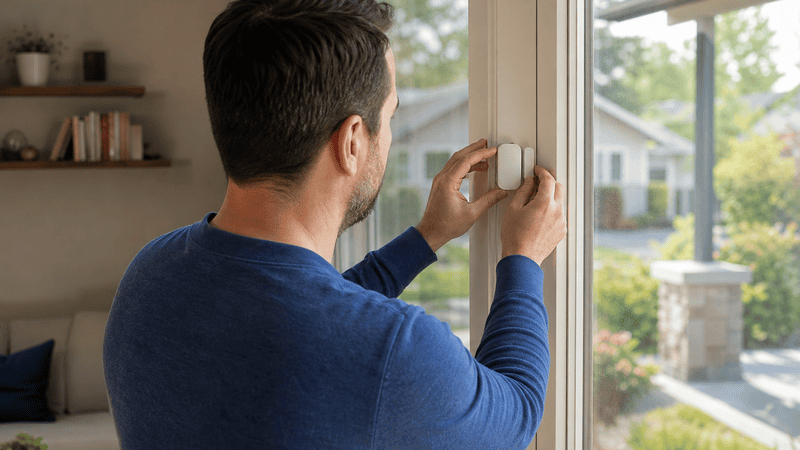
Door alarms guard the entry points intruders use most often — the paths of least resistance. Window alarms cover the entry points people forget, especially ground-floor windows, sliders, and rooms with easy exterior access. Most homes have more vulnerable windows than doors, which is exactly why relying on one without the other leaves a gap in your coverage. The strongest setup uses both, working together so every entry point sounds an alert.
Every alarm has one job: go off before it’s too late to matter. That is the whole point of an alarm — not to punish an intruder after the fact, but to sound loud enough, fast enough, that the moment of opportunity closes before anyone gets inside. I have spent over thirty years figuring out exactly where alarms need to go so that job actually gets done, and I can tell you this with total confidence: the question is not “door or window?” It is “where is each one doing its job, and where are you leaving silence where there should be sound?”
I am here to guide you through exactly where door alarms belong, where window alarms belong, and why the homes I trust most — including my own — run both. By the end of this, you will know precisely where your coverage gaps are and how to close them.
Where should I put door alarms in my home?
Door alarms belong on every door that leads outside and every interior door you need to monitor — bedrooms for sleepwalking family members, a basement door, a nursery. Doors are the entry points burglars overwhelmingly prefer because they are fast, familiar, and often the weakest-secured part of a home despite feeling like the “main” defense.
Front doors, back doors, and side or garage-entry doors should all sound an alarm the moment they open unexpectedly. A good door alarm that actually works gives you two things at once: a loud deterrent that scares off anyone testing the door, and a clear alert that tells you — instantly — that a door has opened when it should not have.
Door alarms also do quiet, everyday work that has nothing to do with intruders. Families use them to track a toddler heading for the garage, alert to a loved one with dementia wandering at 2 a.m., or catch a sleepwalker before they reach the stairs. If any of those situations sound familiar, I would point you toward our dedicated guides on door and window alarms for kids and toddlers, door and window alarms for dementia patients, and door and window alarms for sleepwalkers — each one built around a specific kind of alert, not a generic one.
Where should I put window alarms in my home?
Window alarms belong on every ground-floor window, every window near a fire escape, deck, or low roofline, and any window that can be reached without a ladder. Windows are the quiet entry point — the one homeowners forget because a door feels like “the” way in. That assumption is exactly what creates the gap.
Sliding glass doors deserve window-style alarm coverage too, since they behave more like a wide window than a swinging door. A wireless window alarm mounted on the frame will sound the moment the glass shifts or the track opens, giving you the same instant alert a door alarm gives — just covering the entry point people check last.
Bedroom windows matter more than most homeowners realize. If someone in your household sleeps with a window cracked for air, that window needs its own alarm, independent of whatever is happening at the doors. I always tell customers: an intruder does not care which entry point is easier for you to remember. They care which one is easiest for them to use. Windows are frequently that answer.
Do I really need both window alarms and door alarms?
Yes — and this is the part I want to be completely direct about. A home with door alarms and no window alarms is a home with an open invitation on every ground-floor window. A home with window alarms and no door alarms is missing the entry point burglars try first. Neither setup alone gives you full coverage. Together, they close the loop.
Think of it as a chain of alerts around your home’s perimeter. Every weak link — every silent door, every unmonitored window — is the one spot where an intruder finds no resistance and no sound. Alarms only work when the chain has no gaps. That is not a sales pitch; that is simply how perimeter security functions, whether it is a $12 device or a professionally monitored system.
I have walked through hundreds of homes over the years, and the pattern is always the same: families invest heavily in one and assume it covers everything. The families with the fewest incidents are the ones who treat doors and windows as two separate jobs, both worth doing right.
What’s the difference between how door alarms and window alarms detect an intrusion?
Door alarms typically rely on magnetic contact sensors — one half mounted on the door, one on the frame — that break contact and trigger the alarm the instant the door opens. Window alarms use the same magnetic contact technology on sliding windows, plus vibration or shock sensors on windows that could be shattered instead of opened.
This distinction matters because a window can be breached two ways: opened quietly or broken quickly. A basic contact sensor only catches the first. If you have windows at higher risk — ground floor, hidden from street view, near shrubbery or a fence line — you want a unit with vibration or glass-break detection layered in, not just an open/close contact.
Doors are simpler by comparison. Almost all door intrusions involve the door actually opening or being forced, so a solid contact-based door alarm covers the overwhelming majority of scenarios without needing extra sensor types.
How loud does an alarm need to be to actually work?
An effective door or window alarm should sound between 100 and 130 decibels — loud enough to be heard throughout a home, startle an intruder into abandoning the attempt, and alert every family member, not just the person standing nearby. Anything quieter is closer to a notification chime than a deterrent.
Volume is what turns an alarm from a data point into a defense. A quiet beep tells you something happened after the fact. A 120dB blast stops the moment from continuing. This is the entire philosophy behind Alert-based security: the alarm’s job is to interrupt, not to inform.
If you are outfitting a full home, look for consistent volume across every unit — wired vs. wireless door alarm setups can differ slightly in output and reliability, so it is worth matching your alarm strength to the size of your home and how many rooms the sound needs to travel through.
What about apartments and rentals — do the same rules apply?
Yes, with one adjustment: renters need alarms that protect without permanent installation. Adhesive-mount and pressure-sensitive alarms give apartment dwellers the same door-and-window coverage as homeowners, without violating a lease or leaving marks behind. If you are renting, I would point you toward our full breakdown of door and window alarms for renters and apartments — it covers exactly which units install without damage and still deliver full alarm strength.
Apartment living often means more windows at street level or shared hallway doors that see foot traffic from people who are not your neighbors. That is precisely the kind of environment where skipping window coverage becomes a real gap, not a theoretical one.
Frequently Asked Questions About Window Alarms vs. Door Alarms
Which is more important, a door alarm or a window alarm?
Neither is more important — they cover different entry points. Doors are the entry burglars try first; windows are the entry they use when a door looks secured. A home protected on doors alone still has open ground-floor windows, and a home protected on windows alone still has an unmonitored front door. Full coverage requires both working together.
How many window alarms does a typical home need?
Most homes need one alarm per accessible window — generally every ground-floor window, plus any upper-floor window reachable from a porch roof, deck, or fire escape. A typical single-story home often needs six to ten window alarms, while multi-story homes may need fewer if upper windows are genuinely inaccessible.
Can I use the same alarm system for both doors and windows?
Yes. Many wireless alarm systems use matching sensor units for both doors and windows, all reporting to the same base station or app. This keeps monitoring simple and ensures consistent volume and alert style throughout the home, rather than mixing mismatched systems that behave differently.
Do window alarms work on sliding glass doors?
Yes, and they should. Sliding glass doors function more like wide windows than swinging doors, so a window-style contact alarm — or one with vibration detection — is usually the better fit, since sliders are also common access points for prying and forced entry.
Will a door alarm go off if someone breaks the glass instead of opening the door?
A standard magnetic contact door alarm will not trigger from broken glass alone — it only detects the door opening. If your door has glass panels, look for a unit with added shock or vibration sensing, or reinforce that specific door with a window-style glass-break sensor as well.
Are window alarms harder to install than door alarms?
No, most window alarms install just as easily as door alarms — typically two adhesive-backed magnetic pieces aligned across the window frame and sash. No wiring or drilling is required for most wireless models, making them practical for renters and homeowners alike.
What decibel level should I look for in a home alarm?
Aim for 100 to 130 decibels. This range is loud enough to be heard throughout most homes and startling enough to interrupt an intruder’s attempt, rather than simply logging that an entry occurred. Lower decibel units function more as notifications than actual deterrents.
Should travelers worry about door and window alarms too?
Yes — hotel rooms and short-term rentals often have weaker door security than a home does. Portable alarms designed for travel attach to a door handle or frame in seconds and provide the same instant alert. Pair that with a personal alarm for travelers for coverage that goes with you, not just the room.
Every gap in a home’s alarm coverage is silent until the moment it matters, and that moment is always too late to fix it retroactively. That is why I do not treat door alarms and window alarms as competing choices — I treat them as two halves of the same job. Walk your home’s perimeter with me in mind: every door that opens to the outside, every window within reach of the ground, each one deserves its own alert, sounding the instant something is wrong.
If you are ready to close the gaps in your own home, I encourage you to look through our full range of door and window alarms and match each entry point to the right unit for the job.
Don’t wait until it’s too late. Equip yourself and your Loved Ones with reliable, Self Defense Tools and take control of your personal safety. All the products listed make great, low-cost gifts. Keeping you and your loved ones safe.
Free shipping on orders over $25.
Be Prepared and Be Safe!