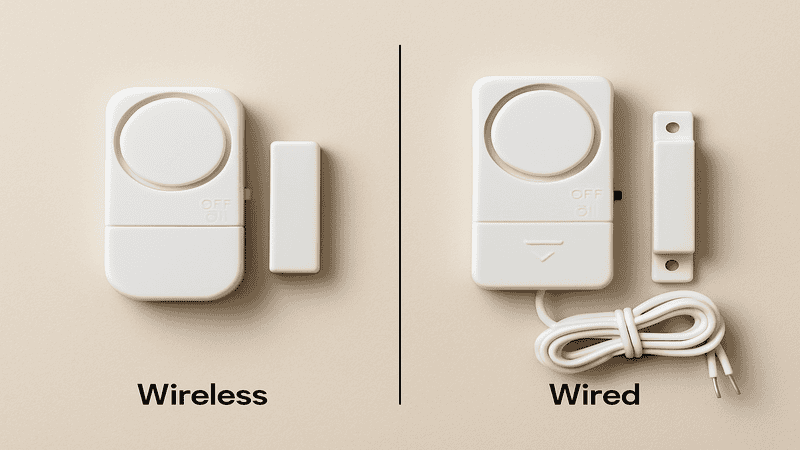
For most homes, wireless window alarms are the practical choice — they install in minutes without any drilling or wiring, work just as effectively as wired systems at the point of entry, and can be repositioned as your family’s needs change. Wired systems offer a more permanent, tamper-resistant setup and are best suited for new construction or whole-home security integrations. The right answer depends on your living situation, your household, and what you are actually trying to protect.
I have been in the security business for more than thirty years, and in all that time, one thing has never changed: the moment that drives people to finally set up window alarms is always personal. It is the night you hear something outside and lie awake wondering. It is the morning you realize your teenager left a window unlocked all night without knowing it. It is the afternoon your neighbor tells you someone tried their back door while they were at the grocery store. Whatever that moment was for you — I am glad it brought you here, because I want to help you make a decision you will feel genuinely good about.
At Family Security USA, I built this company around the belief that every family deserves a clear path to feeling safe at home. Not confused by tech specs. Not overwhelmed by options. Just protected. So let me walk you through wireless versus wired window alarms the way I would explain it to a neighbor standing in my driveway — honestly, warmly, and with your specific household in mind.
Why do window alarms matter so much for home security?
Here is something that took me years in the field to fully appreciate: most break-ins do not start at the front door. Intruders know that front doors are watched, lit, and locked with deadbolts. Windows — especially on ground floors, in back bedrooms, and near garages — are far more likely entry points. Yet most families spend almost no time protecting them.
Window alarms change that equation entirely. They place a loud, immediate alert right at the point of entry, which does two powerful things at once. First, they startle and deter anyone attempting to open that window. Second, they wake up your household and your neighbors. That combination — deterrence plus noise — is remarkably effective, and you do not need a monthly subscription or a professional installation to make it work.
What moves me most about window alarms is how personal the reasons for wanting them can be. Parents of young children set them up so a curious toddler cannot slip out unnoticed. Families caring for a loved one with dementia rely on them for nighttime safety. Renters use them because a landlord’s deadbolt is the only security they were given. Every family’s story is different, and I take each one seriously.
What is the real difference between wireless and wired window alarms?
Let me make this as clear as possible, because the marketing language around home security can make simple things sound complicated.
Wireless window alarms are self-contained units — typically a two-piece magnetic sensor set — that you mount directly on the window frame with adhesive tape or small screws. When the window opens and the two magnetic pieces separate, the alarm sounds. No wires run through your walls. No connection to a central panel is required. They run on batteries, they are completely independent, and they can be installed by anyone in about five minutes.
Wired window alarms are part of a hardwired security system. The sensors on individual windows connect back to a central control panel through wire runs inside your walls. This kind of setup is typically installed during construction or by a professional security contractor. The alarm does not sound at the window itself — it reports to the central panel, which then triggers whatever response has been programmed.
For the vast majority of families reading this right now, wireless is the answer. It is immediate, it is affordable, and it works exactly as well at the critical moment — the moment someone tries to open your window. If you are building a new home and want a fully integrated system, a wired approach makes sense for that project. But for the parent securing a child’s bedroom tonight, or the apartment renter who wants peace of mind without violating a lease, wireless window alarms are the right tool.
How do wireless window alarms actually protect your family?
I want you to picture this scenario with me for a moment. It is 2 a.m. Your family is asleep. A ground-floor window at the back of your home — the one in the guest room that you forget about because nobody uses that room — begins to slide open.
A wireless window alarm does not wait for a signal to travel to a panel. It does not depend on Wi-Fi or a cellular connection. The moment those two magnetic pieces separate, it screams. A good unit hits 100 to 120 decibels — loud enough to wake your whole household and rattle anyone within earshot. That is not a gentle chime. That is a sound that breaks the silence of a quiet neighborhood and makes whoever opened that window want to be anywhere else in the world.
That immediate, on-location response is something I have always valued in simple window alarms over complicated systems. There is no delay. There is no technology in between. The alarm is right there at the window, doing exactly one job, and doing it loudly.
If you have specific household needs — like protecting a child who might wander at night, or adding a layer of safety for a family member with dementia — window alarms take on an even deeper meaning. I have written about this extensively in our guides on door and window alarms for kids and toddlers and door and window alarms for dementia patients, and I would encourage you to read both if either situation touches your family.
When does a wired window alarm system actually make sense?
I want to be fair to wired systems, because they do have a legitimate place. If you are building a custom home or doing a major renovation, integrating hardwired window sensors into your walls from the start is a clean, permanent solution. There are no batteries to replace, no adhesive to fail, and the sensors are essentially invisible once installed.
Wired systems also make sense if you are connecting to a professional monitoring service that will dispatch emergency responders. In those setups, the central panel is the brain — it receives the signal from the window sensor and routes it to a monitoring center or triggers a siren and strobe at the panel itself.
But here is what I tell every homeowner who comes to me asking about wired systems: the cost and complexity are significant. Professional installation runs into the hundreds or thousands of dollars. Running wires through finished walls means drywall work, and every sensor becomes a permanent fixture. If you move, you leave it all behind.
Wireless window alarms, by contrast, go with you. They cost a fraction of what a wired setup requires, and you can add, move, or replace individual sensors any time your life changes. For renters especially — and I have written a dedicated guide on door and window alarms for renters and apartments — wireless is not just an option, it is the only practical one.
How do you choose the right wireless window alarm for your home?
Not all wireless window alarms are created equal, and I want to make sure you walk away from this post knowing what to look for. Here is what I pay attention to when I am recommending sensors to families.
Decibel rating. Look for units in the 100 to 120 dB range. Anything below 100 dB in a bedroom at night may not be loud enough to wake a deep sleeper or be heard from another floor of the house.
Battery life and battery type. Some units run on coin cells that last a year or more. Others use AA or AAA batteries that are easy to find and replace. Choose what works for your household’s maintenance habits — and actually put a reminder on your calendar to check them twice a year.
Magnetic gap tolerance. Windows are not always perfectly aligned. A quality sensor accommodates minor gaps and imperfect surfaces without triggering false alarms. Read product descriptions carefully for gap tolerance specifications.
Mounting method. Adhesive tape is the right choice for renters or painted wood frames where you do not want holes. Screw mounting is more permanent and more secure for homeowners. Some units offer both options.
Additional features. Some wireless window alarms include chime modes — a quieter tone that signals when a window is opened during the day, without sounding a full alarm. If you have children or grandchildren who come and go through certain windows, a chime mode can be genuinely useful alongside the full alarm function.
I also want to mention that window alarms pair beautifully with a broader home security approach. Our portable home alarms resource is a great next read if you want to understand how standalone alarms can layer together into a complete, affordable security system without any central panel or monthly fees.
Can wireless window alarms work alongside a broader home security plan?
Absolutely — and this is where I want to encourage you to think about security as a layered system rather than a single product. No one device is your entire plan. Window alarms handle entry points. Personal alarms give you protection outside the home. Diversion safes protect your valuables inside. Each layer reinforces the others.
One thing I consistently recommend alongside window alarms is a diversion safe for your home. Even if an intruder somehow got past your window alarm — unlikely, but worth planning for — a well-placed diversion safe means your most important items are not where anyone would look for them. That combination of deterrence at the entry point and protection at the valuables is one of the most cost-effective security setups a family can put in place.
If you have ever wondered about what sleepwalking or nighttime wandering looks like as a safety risk, our guide on door and window alarms for sleepwalkers covers that specific situation with real care and detail. It is one of the pieces I am most proud of writing, because it addresses a concern that many families carry quietly and never quite know how to solve.
Frequently Asked Questions About Wireless vs. Wired Window Alarms
Are wireless window alarms as reliable as wired ones?
For the specific job of alerting you when a window opens, wireless window alarms are just as reliable as wired sensors. The magnetic trigger mechanism is simple and consistent. The main difference is that wired systems connect to a central panel, while wireless units sound their alarm independently at the window. For most homes, the wireless approach is equally effective and far easier to install and maintain.
How loud are wireless window alarms?
Most quality wireless window alarms produce 100 to 120 decibels when triggered. To put that in perspective, 120 dB is comparable to a live concert or a chainsaw at close range. That level of sound is loud enough to wake everyone in a typical home and to be heard clearly by neighbors — which is a meaningful deterrent for anyone attempting a break-in.
Will a wireless window alarm work on all window types?
Most wireless window alarms work on sliding windows, double-hung windows, and casement windows. The magnetic sensor is placed on the window frame, and the magnet is placed on the moving sash. As long as the two pieces can sit close together when the window is closed, the alarm will function. For unusual window types or very thick frames, check the product’s gap tolerance specification before purchasing.
Do wireless window alarms need Wi-Fi to work?
Standard standalone wireless window alarms do not require Wi-Fi. They operate entirely on battery power with a direct magnetic trigger — no internet connection, no app, no subscription required. Some smart home security sensors do connect via Wi-Fi or Bluetooth for remote monitoring, but those are a different category. Basic window alarms work independently, which also means they keep working during a power outage or internet disruption.
How long do batteries last in wireless window alarms?
Battery life varies by unit, but most quality wireless window alarms will run for six months to two years on a fresh set of batteries under normal use. The alarm draws very little current in standby mode — it only uses significant power when triggered. Check your units twice a year, ideally when you change your smoke detector batteries, and replace proactively rather than waiting for low-battery warnings.
Can I use wireless window alarms if I rent my apartment?
Yes — wireless window alarms are one of the best security tools available to renters. Most units mount with adhesive tape and leave no permanent marks on frames or walls. They require no hardwiring, no professional installation, and no landlord approval in most cases. When you move, you simply take them with you. They are genuinely designed for exactly this kind of flexible, lease-friendly use.
What is the difference between a window alarm and a window sensor for a smart home system?
A standalone window alarm sounds its alert directly at the window when triggered — no hub, no app, no panel required. A smart home window sensor is a component in a connected system; it reports to a hub or app and may or may not trigger an audible alarm on its own. Both serve a security function, but standalone alarms are simpler, less expensive, and more reliable in situations where you want an immediate, independent response at the entry point.
How many window alarms does a typical home need?
A good starting point is every ground-floor window and any upper-floor windows accessible from a roof, deck, or tree. For most single-family homes, that means somewhere between four and twelve sensors depending on layout. Start with the windows that concern you most — typically those hidden from the street or on the back and sides of the house — and expand from there as your budget allows. Layering protection gradually is far better than waiting until you can cover everything at once.
The question I hear most often from families thinking about window alarms is not really a technical question at all. It is this: Will this actually make a difference? And my answer, drawn from thirty years of watching families go from worried to settled, is yes — it genuinely will. Not because any single device makes a home invincible, but because every layer of protection you add is a quiet act of love for the people sleeping under your roof.
Wireless window alarms give most families exactly what they need: a fast, affordable, reliable alert at every entry point that matters, installed tonight without any tools beyond an adhesive strip. If you are ready to take that next step, I am here to help you choose the right setup for your specific home and household. Browse our selection, reach out with questions, and know that at Family Security USA, you are never navigating this alone.
Don’t wait until it’s too late. Equip yourself and your Loved Ones with reliable, Self Defense Tools and take control of your personal safety. All the products listed make great, low-cost gifts. Keeping you and your loved ones safe.
Free shipping on orders over $25.
Be Prepared and Be Safe!