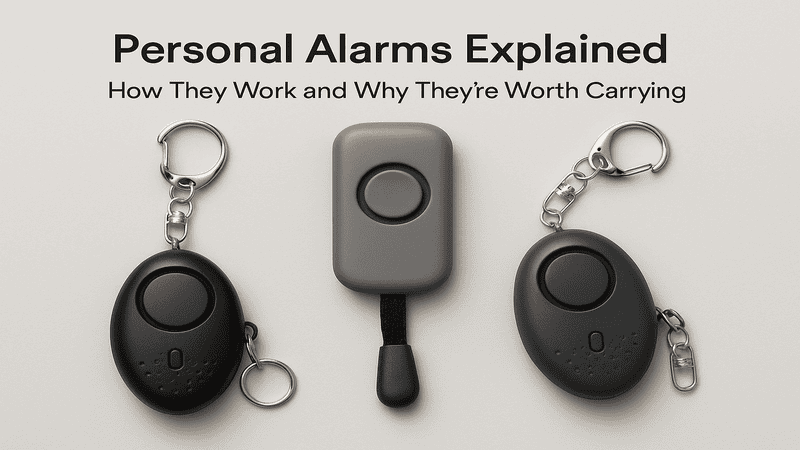
A personal alarm is a compact, handheld device that emits an extremely loud siren — typically between 120 and 140 decibels — when activated, drawing immediate attention to your location and startling or deterring a potential threat. Most models activate with a pin pull, button press, or twist mechanism, require no training to use, and are legal to carry anywhere in the United States. They are among the most universally accessible safety tools available, suitable for children, seniors, college students, runners, and travelers alike.
Why Does Something So Simple Work So Well Against Threats?
Here is a thought that reframes everything: the most dangerous thing about a personal alarm is not what it does to an attacker. It is what it does to an attacker’s plan.
I have spent more than 30 years in the security industry, and one consistent truth I have seen hold across every context — from residential alarm systems to personal safety devices — is this: most criminal behavior depends on low risk and low visibility. A predatory encounter is not usually a random, chaotic explosion. It is a calculated transaction. The person initiating it has chosen a target, assessed the odds, and decided the risk is acceptable. The moment that calculation changes, the situation changes with it.
A 130-decibel alarm does not just make noise. It detonates an invisible signal that says: this person is no longer a quiet, unnoticed target. Bystanders turn. Witnesses appear. The careful anonymity of the encounter collapses. And that, far more than any physical deterrent, is what disrupts a threat before it escalates. I want to walk you through exactly how that works — and why the science behind it is more surprising than most people expect.
How Does a Personal Alarm Actually Produce That Much Sound?
Most people assume a personal alarm is just a very loud buzzer. The engineering reality is considerably more interesting than that — and understanding it helps you choose a device that will actually perform when it counts.
Personal alarms use a piezoelectric speaker or a small electromagnetic transducer to convert electrical energy into sound waves. The decibel output is not a function of size alone — it is determined by the efficiency of that transducer, the resonance chamber design, and the power delivery from the battery. A well-engineered device the size of a car key can legitimately produce 130 decibels. A poorly designed one that claims 140 decibels on the packaging may actually measure 10 to 15 decibels lower in real-world conditions.
To put 130 decibels in perspective: a jet engine at 100 feet registers approximately 140 decibels. A chainsaw runs around 110. The threshold for immediate hearing pain is roughly 125 decibels. When a quality personal alarm fires at full output, it is not merely unpleasant — it is physiologically disorienting. That disorientation buys you seconds, and in a personal safety situation, seconds are everything. Some models, like those in the personal alarm strobe light category, add a simultaneous blinding flash that compounds the sensory disruption in the dark.
Beyond raw output, activation mechanism matters enormously. Pin-pull designs are the most common — you carry the alarm in hand and the attached pin remains clipped to your bag or clothing. If the alarm is grabbed or you need to activate it under stress, the pin separates and the siren fires automatically. This passive activation feature is particularly valuable because fine motor skills degrade sharply under adrenaline. You do not need to find a button. You do not need to look at the device. The motion itself triggers protection.
What Makes a Personal Alarm Different From Other Non-Lethal Options?
This is where the innovation story gets genuinely interesting, because the conventional framing pits personal alarms against tools like pepper spray or stun guns as if they are competing for the same job. They are not. They operate in entirely different threat layers.
Pepper spray and stun guns are reactive tools. They require physical proximity to a threat, a clear opportunity to deploy, and enough composure under extreme stress to aim and activate correctly. They are powerful options — and I carry them myself — but they are tools for when prevention has already failed. A personal alarm, by contrast, is a deterrence and disruption tool. Its job is to change the environment around you so dramatically that the threat recalculates before any physical confrontation begins.
Think of it this way: a pepper spray is the fire extinguisher. A personal alarm is the smoke detector. Both matter. But the smoke detector gives you a chance to prevent the fire from spreading in the first place. I explore this comparison in much more depth in our post on personal alarm vs. pepper spray — and I think it will shift the way you think about layering your personal safety plan.
There is also the accessibility dimension, which deserves more attention than it typically receives. A 130-decibel alarm requires zero physical strength, zero training, zero experience with self-defense. A 75-year-old with arthritis can activate a pin-pull alarm just as effectively as a 25-year-old athlete. That universality is not a compromise — it is one of the most sophisticated design achievements in personal safety technology. Our personal alarms for elderly section covers this in detail, including which activation styles work best for those with limited grip strength.
Who Actually Benefits Most From Carrying a Personal Alarm?
The honest answer is: almost anyone who spends time in public environments where they cannot guarantee their safety. But let me be more specific, because personalization is where real protection lives.
Runners and solo walkers represent one of the highest-value use cases. You are alone, often with headphones in, moving through low-traffic areas at predictable times. The combination of isolation and routine makes you a visible target for opportunistic behavior. A personal alarm clipped to a wristband or running jacket changes that calculus instantly. Our personal alarms for runners page covers the specific form factors and attachment options that work best in motion.
Travelers face a different challenge: unfamiliar environments, inconsistent bystander response, and the complexity of navigating self-defense laws across states and countries. A personal alarm is legal to carry on a plane in your carry-on, requires no special permits, and draws attention in any language. If you move through airports, stay in hotels, or explore unfamiliar neighborhoods, I want you to look at our personal alarms for travelers category — there are purpose-built options there specifically designed for that context.
College students occupy environments where alcohol, crowding, and low-lighting create elevated risk — particularly late at night moving between buildings or parking structures. A personal alarm attached to a backpack zipper pull is always there, always accessible, and requires no decision-making under stress.
Parents of young children are another group I see underserved by conventional safety advice. A child-safe personal alarm teaches awareness, provides a genuine emergency signaling tool, and starts conversations about personal safety at an age-appropriate level — without introducing fear.
What Should You Look for When Choosing a Personal Alarm?
Not all personal alarms are built to the same standard, and the gap between a genuinely effective device and a novelty item wearing safety branding is larger than most buyers realize. Here is what I look for — and what I guide my customers toward after more than three decades of evaluating safety products.
Decibel output verified at distance. A device rated at 140dB at the speaker may measure considerably less at ten feet in open air. Look for honest ratings — 120 to 130 decibels at a measured distance is typically more credible than inflated peak claims.
Activation mechanism that works under stress. As I mentioned earlier, fine motor skills collapse under adrenaline. A pin-pull design that fires on separation is more reliable in an actual emergency than a button you need to press and hold. Test your device so the activation motion is automatic and familiar.
Battery life and type. Replaceable batteries — particularly standard AAA or CR2 types — are preferable for everyday carry tools. You do not want a personal alarm with a proprietary rechargeable battery that fails between charges without warning. Know your battery status.
Durability and weather resistance. A device you carry while running in rain or keep in a bag that gets dropped needs to survive those conditions. Look for solid construction with no exposed electronic components.
Additional features that serve your context. Some models include a built-in LED flashlight, others incorporate a blinding strobe for nighttime use. Our overview of best personal safety alarm devices walks through how to match specific features to your lifestyle and threat environment.
How Should a Personal Alarm Fit Into a Broader Safety Plan?
This question might be the most important one in this entire post, because a personal alarm that sits in the bottom of a bag is not a safety tool — it is false confidence. The device only protects you if it is accessible in the moment you need it, and that requires intentional habits.
I recommend thinking about your personal alarm the same way you think about a seatbelt. You do not wait for an accident to buckle up. You do not leave the driveway without it. The habit is automatic because you have decided in advance that it is non-negotiable. That same commitment to consistent carry is what transforms a personal alarm from a good idea into actual protection.
Pair your personal alarm with genuine situational awareness — the practice of reading your environment before a situation escalates. Our post on how situational awareness lets you avoid threats before they become incidents is essential reading alongside this one. An alarm activates a response. Awareness prevents the need to activate it in the first place. Together, they create something neither can provide alone: a complete, layered safety approach that works before, during, and after a threat emerges.
For those who want to go deeper, I also recommend exploring how personal alarms fit alongside other non-lethal options by visiting our personal safety security devices overview. I am here to guide you through all of it — at whatever pace and depth makes sense for where you are in your safety journey.
Frequently Asked Questions About Personal Alarms
How loud is a 130-decibel personal alarm compared to everyday sounds?
A 130-decibel alarm is louder than a chainsaw, a rock concert, and most power tools. At that level, the sound is physiologically disorienting and causes immediate pain if sustained near the ear. In practical terms, it is loud enough to be heard across a parking lot, inside a building, or through a closed car window — which is exactly what makes it effective at drawing bystander attention.
Are personal alarms legal to carry everywhere?
Yes, personal alarms are legal to carry in all 50 U.S. states and most countries, including on airplanes in carry-on luggage. Unlike pepper spray or stun guns, they have no legal restrictions based on age, location, or permit status. This makes them one of the most universally accessible personal safety tools available — appropriate for children, travelers, and anyone in a regulated environment.
Can a personal alarm actually stop an attacker?
A personal alarm does not physically stop an attacker — that is not its role. Its function is deterrence and disruption. The sudden, extreme noise draws bystander attention, signals your location, and collapses the low-visibility conditions that most opportunistic threats depend on. Most incidents are abandoned when the threat’s cover is removed. The alarm changes the risk calculation before physical confrontation occurs.
How long does a personal alarm battery last?
Battery life varies by model and usage. Most personal alarms using standard replaceable batteries — AAA or CR2 — will operate continuously for 30 to 60 minutes at full volume before the siren weakens. In everyday carry use, where the alarm is rarely activated, quality batteries last one to two years. Check your battery every six months and replace proactively rather than waiting for failure.
Where is the best place to carry a personal alarm?
The best carry position is wherever the alarm is accessible within one second without looking. Common options include clipped to a bag strap, attached to a lanyard around the neck, clipped to a belt loop, or held in hand during higher-risk moments like parking lot walks or late-night walks. For runners, wristband-style carriers work well. The worst place to carry it is inside a zippered bag compartment — it will not help you there.
What is the difference between a personal alarm and a panic button?
A personal alarm is a standalone acoustic device that produces a loud siren on activation — it requires no cellular connection, no subscription, and no infrastructure. A panic button typically refers to a connected device that silently or audibly alerts a monitoring service, family member, or emergency contact via GPS or cellular network. Both have value, but a personal alarm works immediately and everywhere, with no reliance on signal or battery-powered connectivity.
Can children use personal alarms safely?
Yes, and they are an excellent first personal safety tool for children. The activation mechanism — typically a simple pin pull — requires no strength or fine motor precision. Children should be taught when it is appropriate to use the alarm, how to carry it, and that it is not a toy. Many parents find that introducing a personal alarm naturally opens conversations about situational awareness and safety boundaries in an age-appropriate way.
Should I carry a personal alarm even if I also carry pepper spray?
Absolutely. These tools serve different functions and work best in combination. Pepper spray is a reactive tool for close-proximity threats. A personal alarm is a deterrence and disruption tool that works before physical contact occurs. Carrying both means you have a response option at multiple points in a threat’s development — which is precisely what a layered safety approach is designed to provide. Or if pepper sprays are not for you, try one of our Disguised Knives.
Don’t wait until it’s too late. Equip yourself and your Loved Ones with reliable, Self Defense Tools and take control of your personal safety. All the products listed make great, low-cost gifts. Keeping you and your loved ones safe.
Free shipping on orders over $25.
Be Prepared and Be Safe!