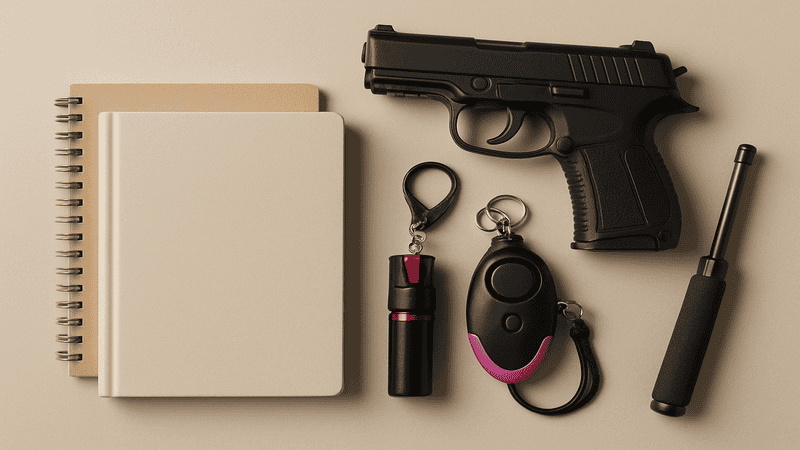
What college students can legally carry for self-defense depends on two things: the laws of the state where the campus is located, and the individual policies of the school itself. In many states, pepper spray is permitted for students over 18, while stun guns and knives face far more restrictions — and some campuses ban all self-defense tools regardless of state law. Before carrying anything, always check your state statutes and your student handbook. When in doubt, non-weapon options like personal alarms are almost universally permitted and can be just as effective.
Every August, millions of families drop a son or daughter off at a college campus and drive home with a knot in the stomach. I know that feeling — I have been in the security industry for more than 30 years, and I have spoken with hundreds of parents who call me not because they are panicking, but because they are responsible. They want to do the right thing. They want their student equipped and prepared without getting them into legal trouble they didn’t see coming.
That is exactly what this post is for. I am going to walk you through what the legal landscape actually looks like for college students when it comes to self-defense, where the real gray areas are, and how to make a confident, well-informed decision for your family. This is not about fear. It is about knowledge — because knowledge is the foundation of real safety.
Why are self-defense laws for college students so confusing?
The honest answer is that the confusion is built into the system. Self-defense rights for college students sit at the intersection of three different layers of authority: federal law, state law, and campus policy. Each layer can restrict what is permitted at the previous level, but none of them can expand it. That layered structure is what makes this topic feel so murky.
Federal law establishes the outer boundaries — for instance, firearms on federally funded campuses are governed by the Gun-Free School Zones Act. State law then defines what weapons are legal to possess for civilians, what age restrictions apply, and whether concealed carry permits extend to college campuses. Finally, individual universities and colleges set their own codes of conduct, and many schools prohibit items that would otherwise be completely legal under state law.
What that means in practice is this: a 20-year-old student in one state may be able to legally carry a stun gun on a public university campus, while a student at a private university in the same state may face expulsion for the same item — even though no law was broken. Understanding which set of rules applies to your specific student, at their specific school, in their specific state, is the only way to navigate this correctly. I will help you build that picture piece by piece.
What self-defense items are college students most commonly allowed to carry?
Let me start with what is most widely permitted, because I want you to feel reassured that there are good, legal options available to your student. Personal alarms are the single most universally accepted personal safety tool on campuses across the country. A quality 130dB personal alarm emits a sound loud enough to be heard across a parking lot, attracts immediate attention, and deters would-be attackers without posing any legal risk. I recommend every college student carry one — no asterisks, no exceptions.
Pepper spray is legal for civilians in most states, and permitted on many — though not all — college campuses. Where it is allowed, there are often conditions: the carrier must be 18 or older, the canister must be below a certain fluid ounce capacity, and the formula may not exceed a certain concentration. Mace and Wildfire are two of the brands we carry that are well-regarded for reliability and appropriate formulation. If your student’s campus permits pepper spray, exploring quality pepper spray options is a practical step worth taking.
Self-defense keychains — including kubotans and similar impact tools — occupy a legal gray area that varies by state. Some states define them as weapons and restrict them accordingly. Others do not regulate them at all. Because they are small and discreet, they are popular among college women in particular, but popularity does not equal legality. Always verify before purchasing. Our guide on self-defense keychains for women is a helpful resource for understanding your options.
Are stun guns and tasers legal on college campuses?
This is one of the most common questions I receive, and the answer requires real care. Stun guns and TASERs are legal for civilian ownership in most — but not all — U.S. states. Hawaii, Rhode Island, and certain other jurisdictions have outright bans or significant restrictions. Several other states require permits or impose age restrictions beyond the standard 18.
Even in states where stun guns are broadly legal, most public university systems have their own weapons policies that specifically prohibit electroshock devices on campus — in dorms, classrooms, and common areas. Some states, however, have passed legislation that prevents public universities from banning legally owned stun guns. Texas and Colorado are two examples where state law has intervened to protect students’ rights to carry these devices on public campuses.
If your student is in a state and at a school where stun guns are permitted, they can be an effective deterrent. We carry trusted brands including TASER, Runt, BashLite, and Streetwise. If you would like to explore those options, our stun gun category is a good starting point — though I always encourage verifying campus policy before purchase.
Can college students legally carry a knife for self-defense?
Knives are among the most legally complicated tools a college student could consider, and I want to be straightforward with you about that. Most states permit the possession of a standard folding pocketknife with a blade under a certain length — typically three to four inches — but that general permission can be overridden entirely by campus policy. The vast majority of colleges and universities prohibit knives of any kind in campus buildings, and many extend that prohibition to the entire campus.
Beyond campus policy, the intended use matters legally. Carrying a tool for utility purposes — opening boxes, cutting rope — is treated very differently under the law than carrying something explicitly intended as a weapon. The moment a knife is described or categorized as a self-defense weapon in a campus disciplinary hearing or a legal proceeding, the analysis changes significantly.
I am not discouraging you from learning about your options — that is why we maintain a full section on knives for self-defense — but I do want to be your honest guide here. For most college students, a knife is not the right first choice. Start with what is clearly permitted and effective. Build your safety plan on a solid legal foundation.
What happens if a student violates campus weapons policy?
This is a question families do not ask often enough, and it matters more than most people realize. Campus weapons violations are handled through the school’s student conduct process, and the consequences can be serious: suspension, expulsion, and a permanent mark on a student’s academic record. In some cases — particularly when state or federal law is also violated — criminal charges can follow.
What makes this especially important is that ignorance of the policy is almost never accepted as a defense. Student handbooks are considered official notice. When students sign their enrollment agreements, they typically acknowledge having received and agreed to abide by the code of conduct. “I didn’t know” is a hard position to defend before a student conduct board.
The practical implication is simple: look it up before buying anything. Every accredited institution in the United States publishes its student code of conduct, usually on the Dean of Students website. It takes ten minutes to search for the weapons policy and read it carefully. Those ten minutes can save your student years of consequence.
What are the safest legal self-defense options for college students in any state?
After more than three decades in this industry, I have a clear answer to this question, and it comes from watching what actually works for the people I have helped. The safest legal self-defense options for college students are those that are effective, portable, and permitted virtually everywhere. That means personal alarms first. A loud, reliable alarm does not require training, does not require a permit, and cannot be used against you if it is taken. Every student should have one.
Beyond alarms, awareness and habits form the most durable layer of protection. I encourage every family to read our post on self-defense tips for college students — it covers the practical behavioral habits that reduce risk before any tool is ever needed.
For students in states and at schools where pepper spray is explicitly permitted, a compact, reliable canister from a trusted brand is a reasonable next step. Our Pepper Shot and Wildfire formulations are well-suited for students who want something that fits in a pocket or clips to a keychain without drawing attention.
For students who want to maximize their options within the law, I always recommend a layered approach: an alarm, permitted chemical deterrent if applicable, and a clearly legal impact tool if state law and campus policy both allow it. That layered strategy is exactly what I walk families through every day.
Frequently Asked Questions About Self-Defense Rights on Campus
Is pepper spray legal to carry on a college campus?
Pepper spray is legal for adults in most U.S. states, but campus policies vary widely. Many public universities permit it with restrictions — typically requiring the carrier to be 18 or older and limiting canister size. Private institutions often prohibit it outright. Always check your specific school’s student code of conduct before purchasing or carrying pepper spray on campus.
Can college students carry a stun gun or TASER on campus?
It depends on both state law and campus policy. Some states allow stun guns for adults and prohibit universities from banning them. Others restrict or ban them for civilians entirely. Even where state law is permissive, most universities have their own rules that ban electroshock devices. Verify both your state statutes and your school’s weapons policy before carrying a stun gun on campus.
What self-defense items can a college student always legally carry?
Personal alarms are the most universally permitted self-defense tool for college students. They require no permit, have no age restriction, and are not classified as weapons under any state or federal law. A quality 130dB personal alarm is effective, affordable, and legal on virtually every campus in the country. Every college student should carry one regardless of other permitted options.
Does campus weapons policy apply inside dorm rooms?
In most cases, yes. Campus weapons policies typically apply to all university-owned or university-operated property, including residential halls. Keeping a prohibited item in your dorm room — even if you never carry it elsewhere — is generally a violation of the student code of conduct. Check the specific language of your school’s policy, as some schools differentiate between residence halls and other campus areas.
What happens if a student is caught with a prohibited self-defense item on campus?
Consequences can range from confiscation of the item to suspension or expulsion, depending on the school’s conduct policies and the nature of the item. In cases where a state or federal law is also violated, criminal charges are possible. These outcomes can affect academic records, financial aid, and future employment. It is always better to spend a few minutes verifying what is allowed than to risk serious consequences.
Are self-defense keychains and kubotans legal on college campuses?
Self-defense keychains and kubotans occupy a legal gray area. Some states classify them as weapons with corresponding restrictions. Others do not regulate them at all. Campus policies may specifically prohibit them or may not address them directly. Because of this inconsistency, it is important to check both state law and campus policy before carrying any impact-style keychain tool as a self-defense item.
Can a student carry a pocketknife on a college campus?
Most colleges and universities prohibit knives of any kind on campus, including folding pocketknives. Even in states where small pocketknives are broadly legal for adults, campus policy typically overrides that permission within university property. Some schools make exceptions for kitchen or utility knives kept in residence hall kitchens, but carrying a knife as a self-defense tool is almost universally prohibited on campus.
Does the same self-defense law apply at all colleges in a state?
State law sets the minimum standard for civilian possession of self-defense tools, but individual colleges and universities can impose stricter restrictions. Public universities in some states are prohibited by law from banning certain items — like legally owned handguns or stun guns — but this varies by state. Private institutions generally have broader authority to restrict what students may carry on their property, regardless of state law.
Navigating self-defense rights on a college campus is not something any family should have to do alone, and you do not have to. I have been helping parents and students work through these exact questions for years, and my goal is always the same: to help you find a solution that is legal, effective, and right for your student’s specific situation. Start with what is universally permitted — a personal alarm, awareness habits, and a clear understanding of your school’s policy. Build from there.
If you are ready to explore options that may be appropriate for your student, I encourage you to browse our selection of self-defense keychains and personal safety tools — and as always, reach out if you have questions. That is exactly what I am here for.
Don’t wait until it’s too late. Equip yourself and your Loved Ones with reliable, Self Defense Tools and take control of your personal safety. All the products listed make great, low-cost gifts. Keeping you and your loved ones safe.
Free shipping on orders over $25.
Be Prepared and Be Safe!