“`
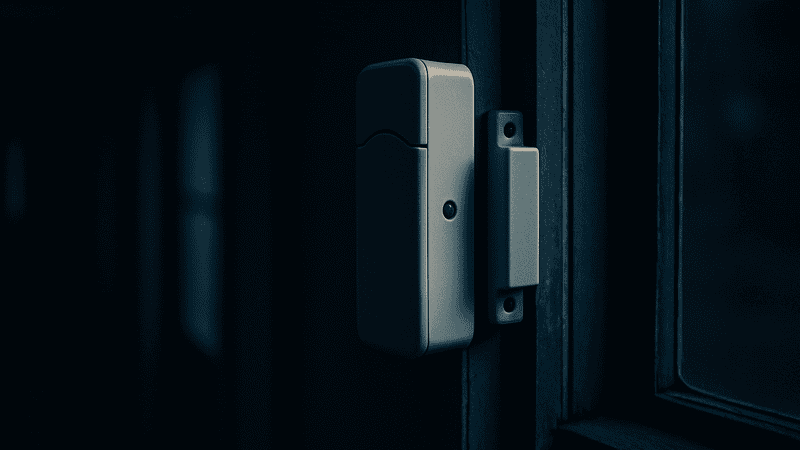
Quick Answer: A magnetic door alarm works through two separate pieces — a sensor unit mounted on the door or window frame, and a small magnet mounted on the moving part of the door or window itself. As long as those two pieces stay aligned within a close range, the circuit stays closed and silent. The instant they separate, even by an inch, the circuit breaks and the alarm sounds. It’s a simple contact-triggered system, but the details of how and where you place those two pieces make the difference between an alarm that works and one that gets ignored.
There’s something almost sleight-of-hand about how a magnetic door alarm operates. Two small plastic pieces, no wires connecting them, sitting a fraction of an inch apart — and somehow, the moment they’re pulled away from each other, the whole house knows about it. Most people who buy one never ask how it actually works. They just trust that it does. But once you understand the quiet mechanics hiding inside that little sensor, you start noticing something else: most people install these things wrong, and never even realize it.
I’ve spent enough years around alarm systems to know that the simplest technology is often the most misunderstood. A magnetic door alarm looks almost too basic to be effective — no cameras, no apps, no monitoring fees. Just two pieces of plastic and a battery. But that simplicity is exactly what makes it worth a closer look. Stick around, because what’s happening inside that sensor — and where most people get the placement wrong — is not what you’d expect.
How does a magnetic door alarm actually work?
Inside the sensor unit sits a small reed switch — a tiny mechanical contact that stays closed only when a magnetic field is present nearby. The second piece, the magnet, does nothing but sit there generating that field. When the two pieces are close together, the magnet keeps the switch closed and the circuit silent. Move the magnet away — by opening a door, sliding a window, or lifting a lid — and the magnetic field disappears. The switch springs open, the circuit completes, and the alarm sounds immediately.
What most people don’t realize is that this happens without any communication between the two pieces. There’s no signal being sent, no pairing process, no battery inside the magnet at all. It’s a passive relationship — one piece simply reacts to the presence or absence of the other. That’s part of what makes these units so reliable. There’s nothing to sync, nothing to lose connection, nothing that can be jammed or intercepted the way wireless signals sometimes can.
The mystery, if there is one, is in the gap tolerance — how far apart the two pieces can drift before the alarm triggers. Cheaper units have a wide, sloppy gap tolerance, which sounds convenient until you realize it means the alarm might not trigger until a door is already several inches open. Better units trigger the moment contact starts to break, giving you the earliest possible warning.
Where should I place the sensor and magnet for the best results?
The sensor piece belongs on the fixed frame — the doorjamb, the window sill, the stationary part that doesn’t move. The magnet belongs on the part that swings, slides, or lifts — the door itself, the window sash, the lid of a box. This sounds obvious until you’re standing there with a screwdriver, and it’s easy to reverse them out of habit.
The two pieces need to sit within roughly a half-inch of each other when the door or window is closed. Too far apart, and the reed switch may never fully engage, which means the alarm could stay silent even when everything appears set. Too close, and repeated contact over time can loosen adhesive backing or shift alignment. This is the quiet failure point nobody talks about — an alarm that looks armed but isn’t actually making contact.
For homes with sleepwalkers, this precision matters even more, since the alarm needs to catch a slow, deliberate opening rather than a sudden slam. If that’s a concern in your household, our door and window alarms for sleepwalkers guide walks through placement strategies built specifically around that scenario.
What’s the difference between magnetic contact alarms and motion-based alarms?
Magnetic contact alarms trigger on separation — motion-based alarms trigger on movement within a space. They solve different problems, and confusing the two is where a lot of buyers end up disappointed. A magnetic alarm won’t detect someone already inside the room. A motion sensor won’t tell you the exact moment a door was opened.
This is where the two-piece contact system quietly outperforms expectations. Because it only reacts to physical separation, it has almost no false alarms from pets, drafts, or shifting light. There’s no need to calibrate sensitivity or worry about a ceiling fan setting it off at 2 a.m. It either detects contact or it doesn’t — and that binary simplicity is exactly why it’s held up as a security staple for decades.
Many households layer both types together. A portable home alarm covering interior movement, paired with magnetic contacts on every entry point, creates overlapping coverage that’s much harder to slip past unnoticed.
Can magnetic door alarms be used on windows too?
Yes — and this is where the two-piece system reveals its real versatility. The same sensor-and-magnet pair that works on a door frame works just as well on a sliding window track, a casement window, or even a cabinet door. Anywhere there’s a fixed surface and a moving surface within close range of each other, the system can be adapted.
This flexibility is part of why these alarms show up in such different households for such different reasons. A family with a curious toddler mounts them low on cabinet doors and exterior exits — something covered in detail in our door and window alarms for kids and toddlers guide. A family caring for a parent with memory loss mounts them at every exterior door to catch wandering before it becomes a crisis, a topic we go deeper on in our door and window alarms for dementia patients page. Same two pieces of plastic. Completely different missions.
Are magnetic door alarms good for renters and apartments?
Yes, and often better suited to renters than hardwired alternatives. Because the two-piece system relies on adhesive mounting or small screws rather than any wiring into the wall or door structure, it can typically be removed at the end of a lease without leaving damage behind. There’s no drilling into frames, no rewiring, nothing that a landlord would flag during a walkthrough.
This makes them a quiet favorite in apartment buildings, shared housing, and temporary living situations where permanent security modifications aren’t allowed. If you’re in that situation, our door and window alarms for renters and apartments page covers mounting options that respect lease restrictions while still giving you real protection.
How loud is the alarm once the two pieces separate?
Most magnetic door alarms sound somewhere between 100 and 130 decibels — loud enough to be heard through walls and startling enough to interrupt whatever’s happening at the point of entry. That volume isn’t arbitrary. It’s calibrated to do two things at once: wake a sleeping household instantly, and make an intruder’s presence known before they’ve had time to get comfortable.
The sound itself is usually a piercing electronic siren rather than a chime or beep, and it starts the moment the magnetic field breaks — not a few seconds later. That immediacy is part of the system’s quiet advantage. There’s no delay for processing, no lag while a sensor “thinks” about whether something happened. Contact breaks, alarm sounds. It’s almost unsettling how instant it is once you’ve seen it in action.
Do magnetic door alarms need a professional to install?
No. This is one of the more surprising things about the two-piece system — it was designed from the start to be handled without tools, wiring, or technical knowledge. Most units use peel-and-stick adhesive backing, and the entire installation process usually takes less than five minutes per door or window.
That said, “easy to install” doesn’t always mean “installed correctly.” The most common mistake isn’t the mounting itself — it’s misjudging the gap tolerance between the sensor and the magnet, or mounting the magnet on the frame instead of the moving surface. A few extra minutes of careful placement is the real difference between an alarm that works flawlessly and one that quietly fails when you need it most.
Frequently Asked Questions About Magnetic Door Alarms
How does a two-piece magnetic door alarm actually detect an opening?
The alarm uses a reed switch inside the sensor piece that stays closed only while a nearby magnet keeps it engaged. When the door or window opens, the magnet moves away, the reed switch springs open, and the circuit completes to trigger the siren — all within a fraction of a second.
Do I need to wire anything for a magnetic door alarm to work?
No wiring is required. The sensor and magnet communicate purely through magnetic field proximity, not electrical connection. Both pieces are typically battery-powered or passive, and installation involves adhesive backing or small screws rather than any electrical work.
Can a magnetic door alarm be fooled by holding a magnet nearby?
It’s a fair concern, but in practice it requires precise knowledge of the sensor’s exact trigger threshold, which varies by unit and isn’t something a casual intruder would attempt or know how to exploit in the seconds they have at an entry point.
Will a magnetic door alarm work on a sliding glass door?
Yes. Sliding doors are one of the most common applications, since the fixed frame and the sliding panel provide a clean, stable surface for mounting each piece. Just make sure the gap between sensor and magnet stays consistent when the door is fully closed.
How far apart can the sensor and magnet be before the alarm won’t work?
Most units require the two pieces to sit within about a half-inch of each other when closed. Beyond that distance, the magnetic field may not be strong enough to keep the reed switch engaged, which can cause the alarm to trigger falsely or fail to arm properly.
Can I use a magnetic door alarm on a rental property without damaging anything?
Yes, most units are designed with adhesive mounting specifically so renters can install and remove them without drilling or leaving marks. This makes them one of the more lease-friendly security options available for apartments and shared housing.
How long does the battery last in a magnetic door alarm?
Battery life varies by unit and usage, but most sensors are built to run for months on standard batteries under normal household conditions, since the circuit only draws power during the brief moment the alarm actually sounds.
What’s the difference between a magnetic door alarm and a personal alarm?
A magnetic door alarm protects a fixed entry point and triggers automatically on contact separation. A personal alarm is carried on your body and triggered manually, making the two products complementary rather than interchangeable — one guards the home, the other guards you when you’re away from it, as covered in our personal alarms for travelers guide.
What makes the magnetic door alarm worth understanding isn’t just the mechanism — it’s the quiet confidence that comes from knowing exactly what’s happening behind that little plastic housing. Once you know how the sensor and magnet depend on each other, you stop treating placement as an afterthought and start treating it as the whole game. That half-inch of tolerance, that instant trigger, that passive simplicity — it’s not flashy, but it’s exactly the kind of quiet reliability that holds up when everything else in the house has gone still. Take a look through our full lineup and see which configuration fits the doors and windows you’re protecting.
Be Prepared and Be Safe!