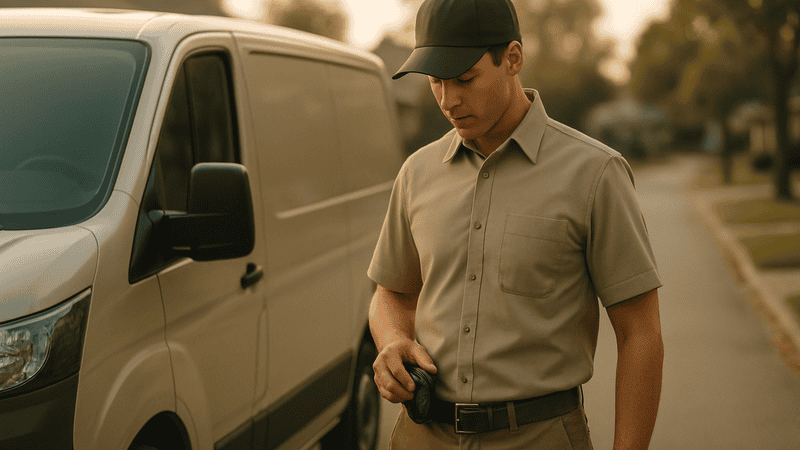
Delivery drivers can legally carry most non-lethal self-defense tools—including pepper spray, personal alarms, and stun devices—in the majority of states, but employer policy and local regulations vary by tool type and jurisdiction. The professional approach is to choose tools that are legal in your operating area, permitted by your employer or gig platform, and suited to the split-second demands of the job. Always verify current state and municipal law before carrying, since rules differ by product category and can change.
Not every delivery driver carries protection. The ones who do it right, however, share something in common: they treat the decision with the same discernment they’d bring to choosing a reliable vehicle or a dependable route app. This isn’t about fear. It’s about professionalism—about recognizing that your safety on the job deserves the same level of consideration as your delivery times.
If you’re driving for a package carrier, a food delivery platform, or running your own routes, you already know the job puts you in unfamiliar driveways, dim parking lots, and neighborhoods you’ve never seen before, often after dark. The drivers who handle this best aren’t the ones carrying the flashiest gear. They’re the ones who understand exactly what the law allows, what their employer expects, and what actually works when it matters. That’s the standard worth meeting.
Is it legal for delivery drivers to carry pepper spray?
Yes, pepper spray is legal to carry in nearly every state for personal protection, making it one of the most accessible options for working drivers. A small number of states impose restrictions on canister size, formulation strength, or require the buyer to be a certain age, so a quick check of your state’s specific statute is worth the five minutes it takes.
What separates a driver who carries with confidence from one who’s simply hoping for the best is knowing the details. Some states cap civilian-grade pepper spray at a maximum percentage of active ingredient. Others restrict certain delivery mechanisms, like foam or gel, differently than traditional spray. A driver who has done the homework carries with certainty, not guesswork—and that certainty shows up in how calmly they handle themselves on the job.
For drivers specifically navigating gig platforms, our guide to pepper spray for Amazon drivers breaks down formulations and carry options built for the pace and unpredictability of route-based work.
Can delivery drivers carry a stun gun in their vehicle?
In most states, yes—stun guns and similar contact-based devices are legal for civilian carry, though a handful of states and cities restrict or ban them outright, and it’s the driver’s responsibility to know which category they fall into. This is where the professional distinguishes themselves from the casual carrier: verifying local law isn’t optional, it’s foundational.
States like New York and Rhode Island have historically restricted stun device carry, while most others permit it with few conditions beyond age and lack of felony record. Because delivery routes frequently cross city and county lines, a driver working a metro area should confirm rules in every jurisdiction they regularly enter—not just where they live.
Drivers who walk dogs, make evening deliveries, or work irregular hours often look at options built for close encounters and quick access. Our breakdown of a stun gun for walking at night applies just as well to a driver stepping out of a vehicle in low light, where speed of deployment matters as much as legality.
Do delivery companies allow drivers to carry self-defense tools?
Policy varies significantly by employer, and this is the piece most drivers overlook. A tool can be perfectly legal under state law and still violate your delivery platform’s terms of service or your employer’s internal conduct policy. The discerning driver checks both before ever clipping a device to their belt or tucking it into a door pocket.
Major carriers and gig platforms generally do not prohibit passive deterrents like pepper spray or personal alarms, since these tools don’t require aggressive action to be effective. Policies get more particular around anything resembling a weapon in appearance, which is why understanding how your employer defines “self-defense tool” versus “weapon” matters before your first shift, not after an incident.
If your role involves reading a written policy, look specifically for language around “carrying items for personal protection” or “prohibited items in vehicle.” When in doubt, a quick conversation with a supervisor or dispatcher settles it faster than assumption ever will.
What is the best self-defense tool for a delivery driver to carry?
The best tool is the one matched to your actual working conditions—your typical hours, the density of the areas you serve, and how quickly you need to access it from a driver’s seat or a walking position. There is no single answer that fits every route, which is precisely why generic advice falls short for professionals who take this seriously.
A driver working suburban daylight routes has different needs than one delivering food downtown after 10 p.m. The former may find a compact pepper spray for Amazon drivers sufficient, worn on a belt clip for instant access. The latter may want to layer that with a 130-decibel personal alarm that draws immediate attention in a populated area, or a discreet contact stun device for closer encounters where distance isn’t an option.
Our full guide on the six self-defense tools every delivery driver should have on every route walks through how to layer these tools by scenario rather than relying on a single item to cover every situation. That layered approach is what separates a driver who’s genuinely prepared from one who bought a single product and called it done.
Can I keep pepper spray or a stun gun in my delivery vehicle?
Yes, in nearly all states you may store self-defense tools in your vehicle, though a small number of jurisdictions have specific rules about where in the vehicle certain items must be kept. For most drivers, the more practical question isn’t legality—it’s accessibility. A tool locked in a glovebox or buried under a seat does nothing for you at the moment you need it.
Professionals who take this seriously mount or position their chosen tool where it can be reached in seconds: a door pocket, a console clip, or worn directly on the body when stepping out for a delivery. The tool’s value is directly tied to how quickly you can deploy it, which is a detail too many drivers realize only after it’s too late to matter.
How is pepper spray different from bear spray for driver protection?
Pepper spray formulated for human threats and bear spray are not interchangeable, and using the wrong one can mean the difference between an effective deterrent and a legal or practical misstep. Bear spray is formulated and regulated for use against wildlife, dispenses in a wide fog pattern meant for large animals at distance, and carries different legal classifications in some states when used against a person.
Delivery drivers should specifically choose spray formulated and labeled for human self-defense, which typically comes in a stream, cone, or gel pattern designed for accuracy and control in close encounters with a person. For a full comparison of the two, our post on bear spray versus pepper spray for human threats lays out exactly why this distinction matters before you ever need to use either.
Frequently Asked Questions About Self-Defense Tools for Delivery Drivers
Do I need a permit to carry pepper spray as a delivery driver?
Most states do not require a permit to carry pepper spray for personal protection, making it one of the most accessible tools for working drivers. A few states impose age restrictions or minor registration requirements, so confirming your specific state’s law before purchase ensures you’re carrying with full confidence.
Can my employer fire me for carrying a self-defense tool?
It depends entirely on your employer’s written policy. Some companies explicitly permit passive deterrents like pepper spray, while others restrict anything resembling a weapon. Reviewing your employer’s conduct policy or asking a supervisor directly before carrying protects both your safety and your job.
Is it legal to carry a stun gun while driving for a food delivery app?
In most states, yes, provided you meet age requirements and have no disqualifying record. A handful of states restrict or ban stun devices entirely. Because delivery routes often cross city and county lines, confirm the law in every jurisdiction you regularly work, not just your home address.
What self-defense tool is easiest to use while making deliveries?
Pepper spray with a belt clip or personal alarms with a keychain attachment tend to offer the fastest, most intuitive access for drivers moving quickly between vehicle and doorstep. The right tool is one you can deploy without hesitation, which is why practicing quick access matters as much as the tool itself.
Can I carry self-defense tools across state lines during a delivery route?
Laws vary by state, and a tool legal in one state may face restrictions in another. Drivers who regularly cross state lines should verify the law in every state along their route, since carrying an item that’s restricted in a neighboring state can create legal complications even during a brief pass-through.
Are personal alarms considered self-defense weapons under the law?
No, personal alarms are sound-based deterrent devices, not weapons, and are legal virtually everywhere without restriction. This makes them one of the simplest, most universally accepted tools for delivery drivers who want a professional-grade layer of protection with zero legal complexity.
What should I look for when choosing self-defense gear for delivery work?
Prioritize tools matched to your actual working hours and environment, ease of one-handed access, and confirmed legality in every jurisdiction you serve. A driver working nights in dense urban areas has different needs than one covering daylight suburban routes—choose accordingly rather than defaulting to whatever’s most popular.
Where can I find self-defense tools designed specifically for delivery drivers?
Our curated selection of best self-defense tools includes options built for professionals who need reliable, route-ready protection—from compact sprays to alarms designed for quick deployment between stops.
The drivers who carry with the most confidence are rarely the ones who bought the first product they saw. They’re the ones who took the time to understand their state’s law, their employer’s policy, and their own working conditions—then chose accordingly. That level of care is what separates a genuine safety strategy from an afterthought, and it’s a standard worth holding yourself to every time you start a shift.
If you’re ready to build a setup that reflects real professionalism rather than guesswork, explore our full range of self-defense tools and find the combination suited to your route, your hours, and your peace of mind.
Don’t wait until it’s too late. Equip yourself and your Loved Ones with reliable, Self Defense Tools and take control of your personal safety. All the products listed make great, low-cost gifts. Keeping you and your loved ones safe.
Free shipping on orders over $25.
Be Prepared and Be Safe!